 Battery Technology
 How to Charge Lithium Batteries Safely
06 Aug 2026 · By Enervation Team
How to Charge Lithium Batteries Safely: A Complete Guide
Lithium batteries — whether Li-ion or LiFePO4 (LFP) — power everything from solar setups to e-bikes and backup systems. They're efficient and long-lasting, but only if charged correctly. Charge them the wrong way and you risk poor performance, a shortened lifespan, or in worst cases, thermal runaway. This guide walks through the right ways to charge lithium batteries, why some common shortcuts are dangerous, and the factors that actually matter.
Understanding How Lithium Batteries Want to Be Charged
Lithium batteries are charged using a CC-CV profile — Constant Current, then Constant Voltage.
- Constant Current (CC) stage: The charger pushes a steady current into the battery, and voltage rises gradually as the cells fill up.
- Constant Voltage (CV) stage: Once the battery reaches its target voltage (typically 4.2V/cell for Li-ion, 3.65V/cell for LiFePO4), the charger holds that voltage steady while the current tapers off. Charging is considered complete when the current drops to a small percentage of the rated capacity (often 0.05C).
Any legitimate charging method — solar, grid, or a dedicated charger — needs to replicate this profile accurately, along with cutoffs for overvoltage, overcurrent, and temperature. This is the core reason casual charging methods fall short.
1. Solar Charging
Charging lithium batteries from solar panels requires a charge controller sitting between the panel and the battery. Never connect a solar panel directly to a lithium battery.
MPPT (Maximum Power Point Tracking) controllers are the better choice for lithium setups. They continuously adjust the electrical operating point of the solar array to extract the maximum available power, then convert it to the correct charge voltage and current for the battery. This makes them more efficient (especially in cold or low-light conditions) and lets you use a solar array with a different voltage than the battery bank.
PWM (Pulse Width Modulation) controllers are simpler and cheaper but less efficient. They effectively clamp the panel voltage down to match the battery, wasting the difference as heat. PWM is workable for small setups but a poor match for larger lithium banks.
Whichever controller you use, make sure: - It has a lithium-specific charge profile (correct absorption voltage, no float stage that overcharges lithium the way it would lead-acid). - It has low-temperature charge cutoff, since charging lithium cells below freezing can cause lithium plating on the anode — a real safety and longevity risk. - It communicates with or matches the battery's BMS (Battery Management System) so charging stops if the BMS signals a fault.
2. Grid Charging Through Charge Controllers
For grid-tied or hybrid systems, you'll often charge lithium banks through an AC-coupled or DC charge controller/inverter-charger rather than a raw AC adaptor. These devices:
- Rectify AC to DC and regulate it through the same CC-CV profile.
- Allow you to program lithium-specific voltage set points (bulk, absorption, no false float).
- Often integrate with the BMS via CAN bus or RS485 for closed-loop protection — the controller can throttle or stop charging based on real-time cell data, not just pack voltage.
This is the standard, safe way to charge large lithium battery banks (home storage, off-grid systems) from mains power.
3. Charging Through Dedicated Chargers
For smaller batteries — power tool packs, e-bike batteries, standalone Li-ion/LiFePO4 packs — use a charger designed for that specific battery chemistry and voltage. A proper lithium charger will:
- Match the cell chemistry's exact voltage and current specifications.
- Execute a full CC-CV cycle with a defined end-of-charge cutoff.
- Include safety timers and temperature sensing.
- Often communicate with an onboard BMS to enable cell balancing during charging.
Using the charger that came with the battery, or one explicitly rated for that chemistry and voltage, removes most of the guesswork and risk.
Why Not to Charge With SMPS or Wall Adaptors
It's tempting to think "it's just DC power, any adaptor of the right voltage should work." This is one of the most common — and riskiest — mistakes.
A generic SMPS (Switch Mode Power Supply) or phone-style adaptor is built to deliver a fixed voltage, not to manage a charge cycle. Here's what it's missing:
- No CV tapering: A basic SMPS holds output voltage but doesn't intelligently taper current as the battery approaches full charge the way a real lithium charger does — this can push cells past their safe voltage limit, especially as the battery ages and its internal resistance changes.
- No overcharge cutoff: Without a defined end-of-charge algorithm, there's nothing to reliably stop the current once the battery is full, especially if there's no BMS or the BMS is basic.
- No BMS communication: Many SMPS/adaptor setups charge the pack as a whole without any cell-level balancing or fault feedback, so weak or imbalanced cells within a pack can be overcharged even while the rest are still charging.
- No temperature protection: A dedicated charger typically monitors battery temperature and halts charging if it climbs too high. A basic adaptor has no idea what's happening inside the battery.
- Voltage sag and ripple: Cheap SMPS units often have poor voltage regulation and higher output ripple than a purpose-built charger, which can subject cells to voltage spikes.
- No current limiting matched to the pack: Adaptors are typically designed for constant loads (like powering a router), not for the variable current draw of a charging battery — this can result in current levels the battery or its wiring isn't rated for.
Put simply: an SMPS can supply the right voltage, but charging a lithium battery isn't just about voltage — it's a controlled process. Skipping that process is how overcharging, excess heat, and in rare cases, thermal runaway happen.
Why Not to Charge Lithium With a Lead-Acid Charger
Swapping in an old lead-acid charger to charge a lithium battery is another common — and risky — shortcut, especially in solar and off-grid setups where people are simply replacing a lead-acid bank with lithium. The two chemistries charge very differently, and a lead-acid charger's logic doesn't translate:
- Wrong voltage set points: Lead-acid charging profiles use bulk, absorption, and float voltages tuned for lead-acid chemistry (often higher than what a lithium cell needs at full charge). Applying these to lithium can push cells above their safe voltage ceiling.
- The float stage is a problem: Lead-acid chargers are designed to trickle-charge indefinitely at a "float" voltage to keep the battery topped up. Lithium batteries don't want this — holding them at a float voltage for extended periods accelerates degradation and adds unnecessary stress, unlike lead-acid, which tolerates and even needs it.
- Different temperature compensation: Lead-acid chargers often adjust voltage based on temperature curves specific to lead-acid electrochemistry. Applied to lithium, this compensation is simply wrong and can push charging outside lithium's safe window.
- No BMS communication: Lead-acid chargers have no concept of a BMS or cell balancing — they were designed for a chemistry that doesn't have those systems, so they can't respond to lithium-specific fault signals.
- Multi-stage charging mismatch: Lead-acid's multi-stage (bulk-absorb-float, sometimes equalization) profile includes an equalization phase that intentionally overvoltages the battery to balance internal chemistry — this is standard and safe for lead-acid but can be damaging or dangerous for lithium cells.
The short version: lead-acid and lithium batteries are charged with fundamentally different voltage curves and philosophies. Always use a charger or charge controller with a lithium-specific charge profile (or one that lets you manually select LiFePO4/Li-ion settings) rather than assuming a lead-acid charger is "close enough."
Key Factors in Safe Lithium Charging
C-Rate and Its Relationship With Charge Rate
C-rate describes charge or discharge current relative to a battery's capacity. A 1C rate means a current equal to the battery's rated capacity in amp-hours — so for a 100Ah battery, 1C = 100A. A 0.5C rate would be 50A, and a 2C rate would be 200A.
This matters directly for charging speed and safety:
- Higher C-rate = faster charge, but more heat and stress. Charging at 1C can theoretically fill a battery in about an hour, but it generates more internal heat and accelerates degradation compared to a slower rate.
- Most lithium batteries are safely charged between 0.2C and 0.5C for everyday use — meaning a 100Ah battery is charged at 20–50A. Manufacturers specify a maximum safe charge C-rate; exceeding it voids warranties and risks damage.
- LiFePO4 generally tolerates higher C-rates than standard Li-ion (NMC/LCO) due to its more thermally stable chemistry, but "tolerates" doesn't mean "ignore the spec sheet" — always check the manufacturer's rating.
- The CV stage's tail current is also expressed in C-rate (commonly 0.05C) — this is the cutoff point where the charger considers the battery full.
In short: a higher C-rate charger isn't automatically better. Match the charge current to what the specific battery and its BMS are rated to handle.
Temperature
Lithium batteries have a narrow safe charging temperature window — typically 0°C to 45°C (32°F to 113°F) for charging (discharge tolerance is usually wider). Charging below freezing risks lithium plating, which permanently reduces capacity and can create internal short-circuit risks. Good chargers and BMS units include temperature sensors that pause or block charging outside this range.
Battery Management System (BMS)
The BMS is the safety brain of a lithium pack. It handles: - Cell balancing — ensuring all cells in a series string charge to the same voltage, since even small imbalances compound over cycles. - Overvoltage/undervoltage protection — cutting charging or discharging if any cell goes out of safe range. - Overcurrent and short-circuit protection. - Temperature-based cutoffs.
Never bypass or disable a BMS to "charge faster" — it's the single biggest safety layer in the system.
Voltage Accuracy
Lithium cells are sensitive to overvoltage. Even a small overshoot (e.g., charging a cell to 4.3V instead of 4.2V) can meaningfully increase degradation and fire risk over repeated cycles. This is why charger voltage accuracy and calibration matter more for lithium than for older chemistries like lead-acid.
Avoiding Full 0–100% Cycling for Longevity
While not strictly a "safety" factor, keeping lithium batteries roughly between 20% and 80% state of charge for daily use significantly extends cycle life. Charging fully to 100% and immediately unplugging (rather than leaving it at a high state of charge for long periods) is generally fine; it's prolonged storage at full charge, or repeated deep discharges to 0%, that stresses the cells most.
Physical and Environmental Safety
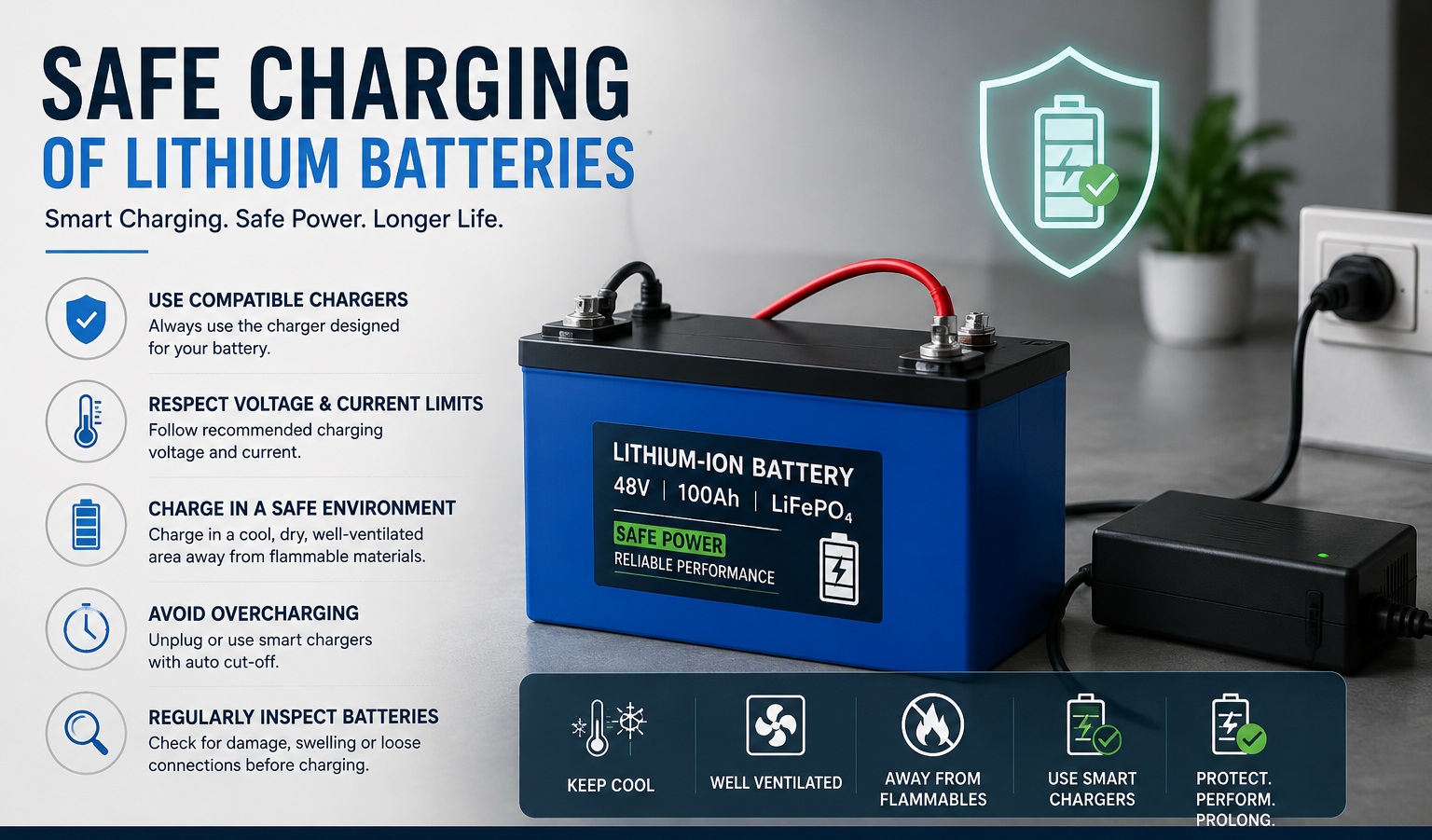
- Charge on a non-flammable surface, away from direct sunlight or heat sources.
- Use correctly rated cables and connectors — undersized wiring is a common cause of overheating during high-current charging.
- Never charge a visibly damaged, swollen, or punctured battery.
- For larger installations, consider a battery enclosure with ventilation and, where appropriate, a fire-rated cabinet or fireproof bag for smaller packs.
The Bottom Line
Lithium batteries reward proper charging with long, reliable service — and punish shortcuts. Whether you're charging from solar, the grid, or a dedicated charger, the goal is the same: deliver a controlled CC-CV profile matched to the battery's chemistry, respect its rated C-rate, and let the BMS do its job. Skip the generic SMPS or wall adaptor, match your charge current to the manufacturer's specs, and keep temperature and voltage within safe limits. It's a small amount of diligence for a battery system that can last for thousands of cycles.
← Back to Knowledge Centre